Lightweight Flange Products
Two configurations, every standard size, built to AWWA C207 and ANSI B16.1 dimensions.
Slip-On Flanges
The most commonly specified lightweight flange type. The pipe slides through the flange bore until the pipe end sits slightly recessed from the flange face, then two fillet welds are applied: one on the hub side, one on the face side. This double-weld configuration provides joint strength approximately two-thirds that of a weld neck connection, which is more than adequate for the pressure ranges these flanges are designed for.
Slip-on flanges are preferred for field installation because they require less precise pipe length measurement than weld neck flanges. The pipe does not need to be cut to exact length since the slip-through bore provides adjustment room. This translates directly to faster installation on large-diameter water mains where cutting and beveling pipe in the trench is time-consuming.
Available in flat face (FF) and raised face (RF) configurations. Flat face is standard for mating with Class 125 cast iron flanged equipment. Raised face is specified when the mating flange is also raised face steel.
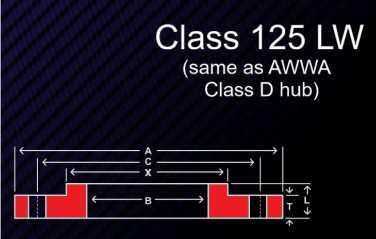
Class 125 LW Slip-On
Same as AWWA Class D hub
Blind Flanges
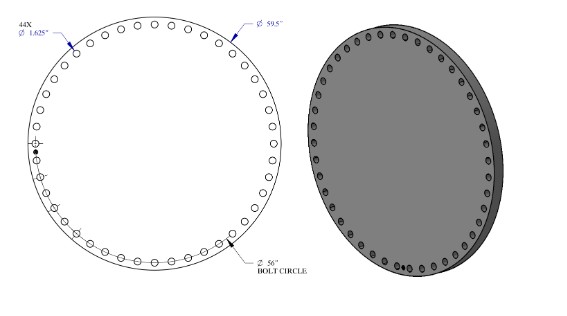
A blind flange is a solid disc with the same bolt hole pattern and outside diameter as the corresponding slip-on flange. No bore, no hub. It bolts to the mating flange and seals the pipe end completely.
Common uses include dead-ending a pipe run, blanking off a nozzle on a tank or vessel, providing access points for hydrostatic testing, and capping future branch connections. In water treatment plants, blind flanges frequently serve as inspection access points that can be unbolted for internal pipe examination.
The lightweight designation means the disc thickness is reduced compared to a standard ASME B16.5 blind. This is structurally acceptable because the working pressures for AWWA C207 service (86 to 300 psi depending on class) are well below the pressure ratings of standard B16.5 Class 150 blinds. The weight savings compound significantly on large-diameter applications where a standard blind for 48" pipe can weigh several hundred pounds.
Material Grades
Standard material is carbon steel per AWWA C207 requirements. Other grades available on request.
| Grade | Specification | Min. Tensile | Min. Yield | Notes |
|---|---|---|---|---|
| A36 | ASTM A36 | 58,000 psi | 36,000 psi | Standard plate flanges |
| A516-70 | ASTM A516 Gr.70 | 70,000 psi | 38,000 psi | Pressure vessel quality plate |
| A105 | ASTM A105 | 70,000 psi | 36,000 psi | Forged carbon steel |
| A350 LF2 | ASTM A350 | 70,000 psi | 36,000 psi | Low-temperature service |